Articles
OpenClaw Just Passed React. Here's What the GitHub Star Leaderboard Actually Looks Like.
An open-source AI agent that's four months old just passed React in GitHub stars. I pulled the data on the top 20 most-starred repos to see what the leaderboard actually looks like.
An open-source AI agent that’s four months old just passed React in GitHub stars. I saw the star-history.com post on Hacker News over the weekend and pulled up the GitHub CLI to check:
gh api repos/openclaw/openclaw --jq '.stargazers_count'Sure enough. OpenClaw, an open-source AI agent that launched in November 2025, had more stars than React. 247,191 vs 243,438.
React. The library behind Instagram, Airbnb, Netflix, and roughly half the web you use every day. The library that held the “most-starred software project” title for years. Overtaken by something that’s been alive for four months.
I had questions. So I pulled the data.
GitHub stars are a messy signal, and that’s the point
Quick context. GitHub was founded in 2008. Stars were introduced in August 2012 (before that, there was a “watch” button that served a similar purpose). So every project on the leaderboard has accumulated stars over at most 14 years.
Stars are not downloads. They’re not usage metrics. They’re not endorsements. A star is the lowest-friction way to say “I noticed this” on the entire internet. One click. No commitment. Somewhere between a bookmark, a like, and a wave.
That matters here.
The leaderboard is not what you’d expect
Here’s what I found when I pulled the top 20 this past week:
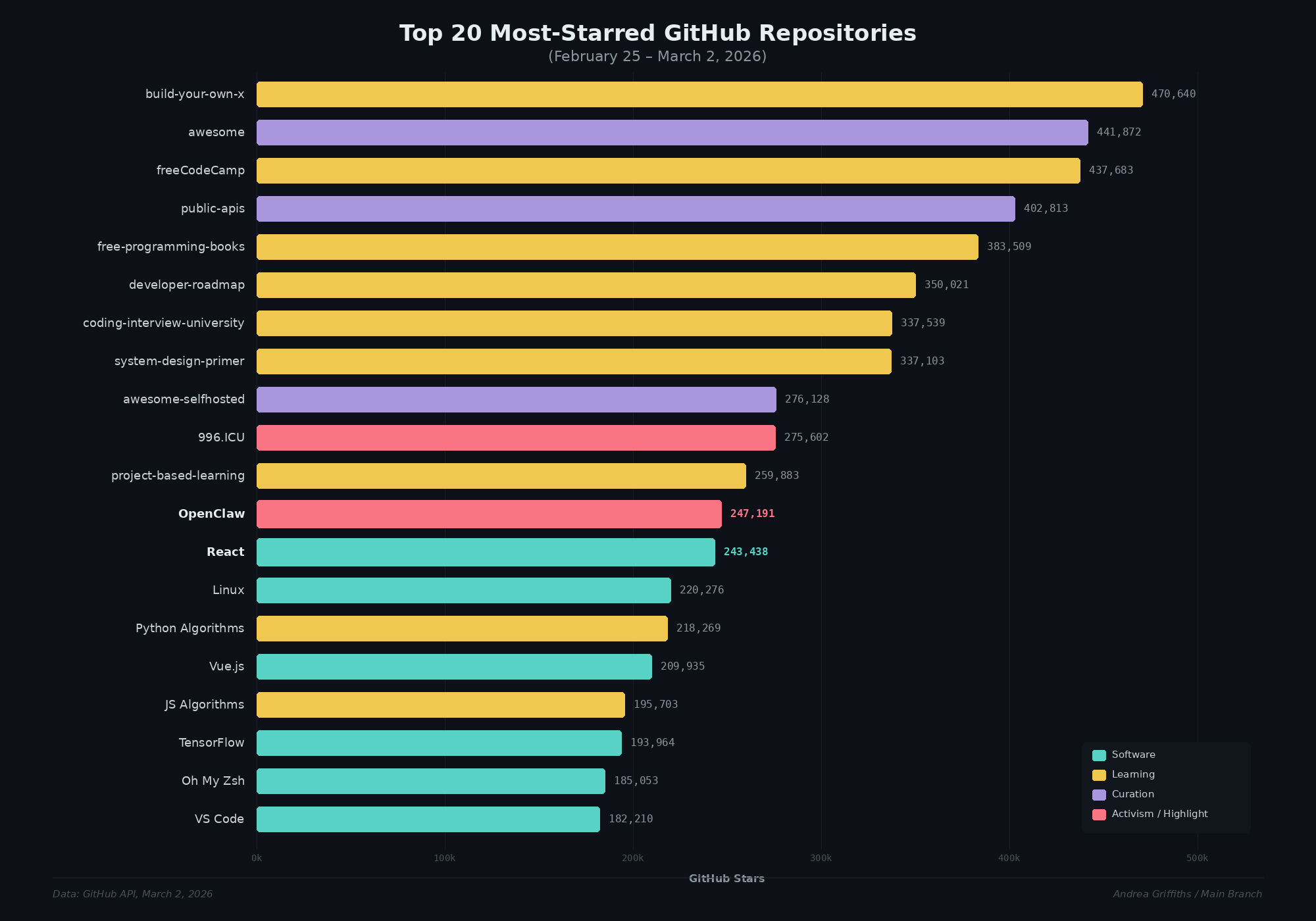
Only 7 of the top 20 are actual software you can install and run. The rest are learning resources, curated lists, and one protest movement (996.ICU, where Chinese developers protested overwork culture in 2019. Still sitting at 275k stars).
There are actually two leaderboards
When people say “most-starred project on GitHub,” they’re picturing a software tool. But the real leaderboard is dominated by aggregators. Collections of links, tutorials, roadmaps, reading lists.
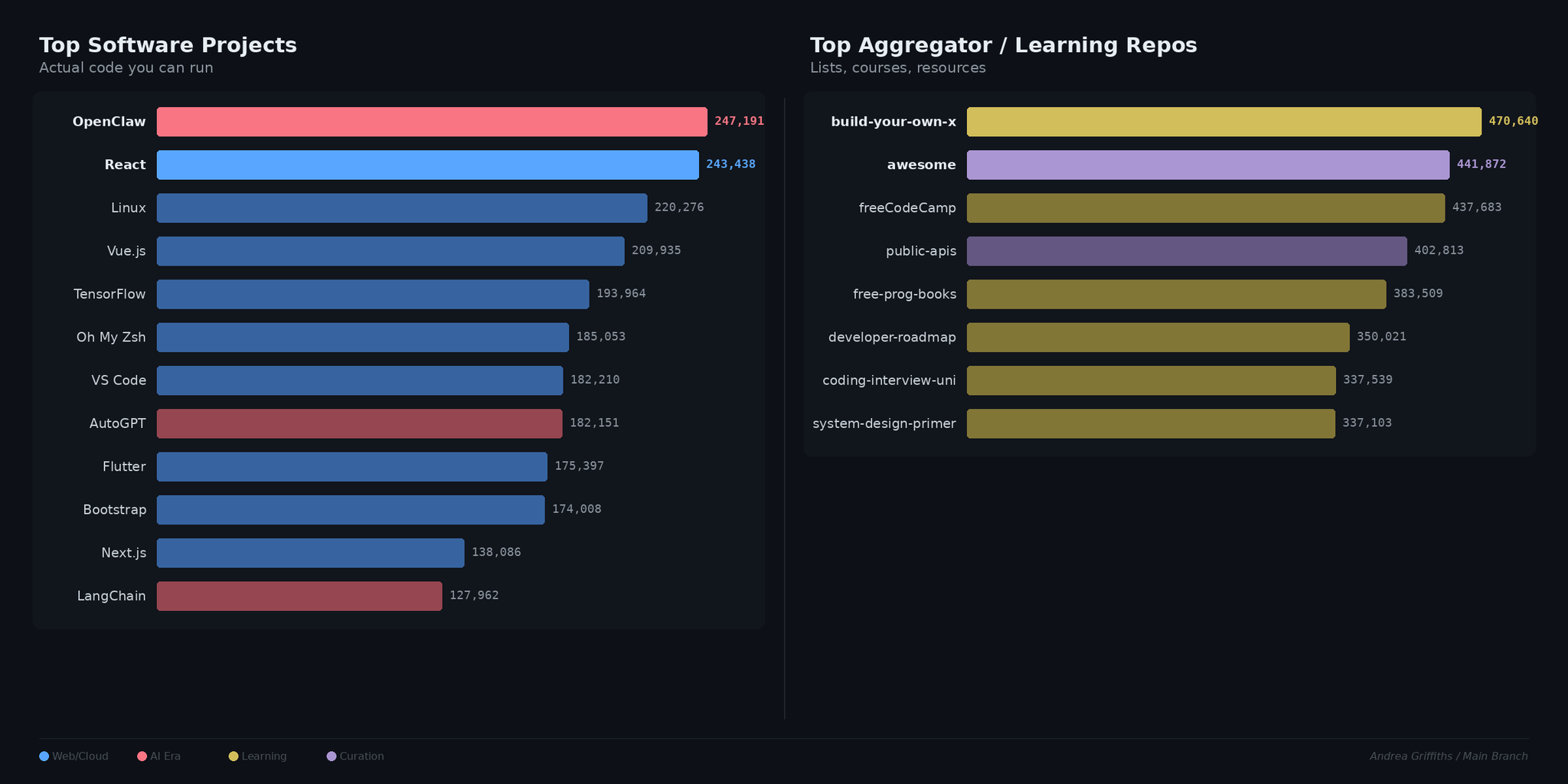
The top aggregator (build-your-own-x at 470k) has nearly double the stars of the top software project. That tells you what developers actually use stars for a lot of the time: bookmarking. “I should read this someday” save the tab energy. I’ve starred repos I’ve never opened. You probably have too.
Strip out the aggregators and ask “what’s the most-starred software project?” and the answer changed. It’s OpenClaw. Before that, it was React.
When were these projects born?
This is where the data gets fun.
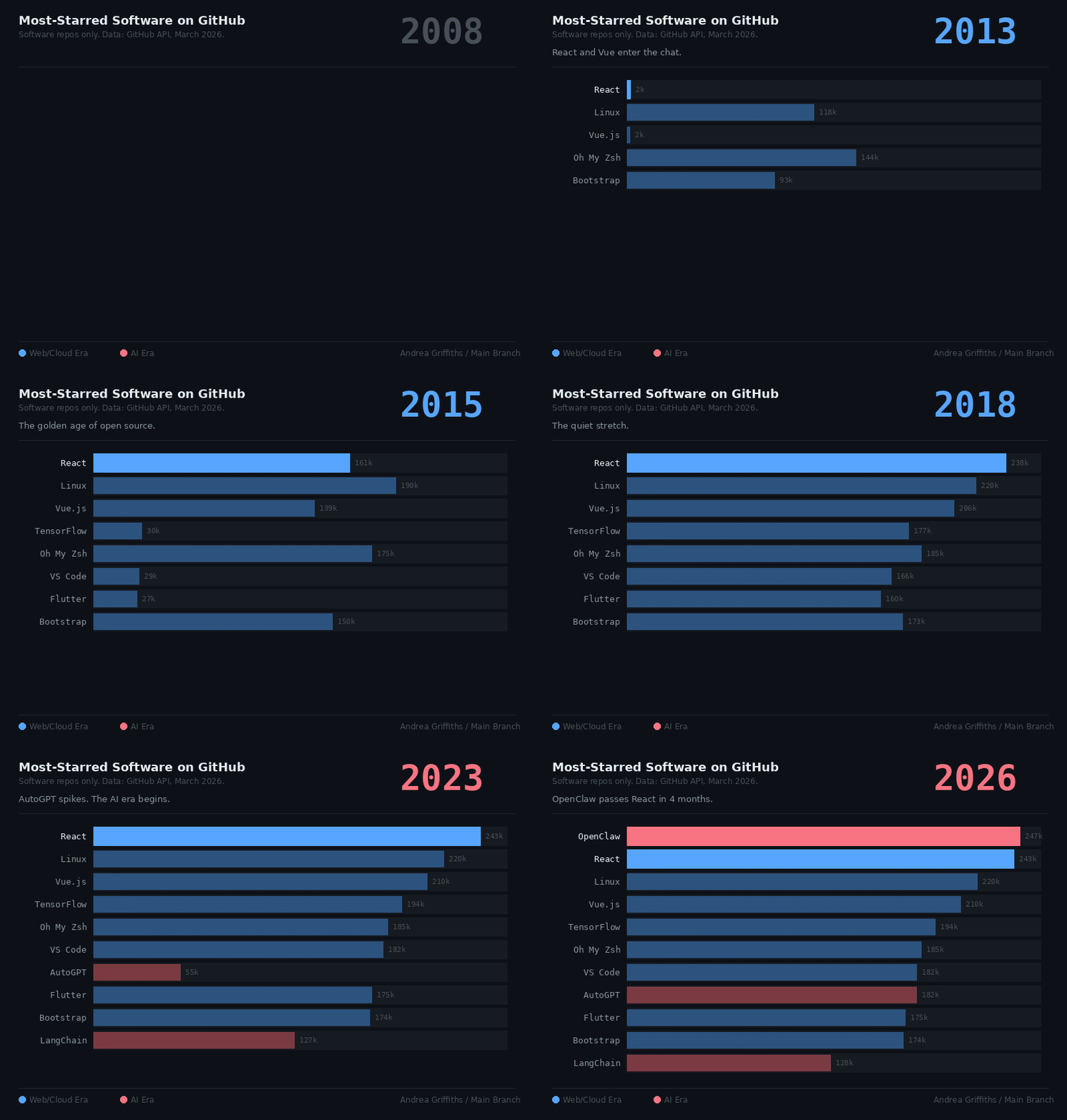
Most of the top software projects were created between 2013 and 2016. React, Vue, Go, Kubernetes, VS Code, Flutter, TypeScript. All born in that window. It was a golden age for open source infrastructure, and the star counts reflect a decade-plus of steady accumulation.
Then there’s a quiet stretch. Between 2019 and 2022, nothing cracked the top 20 in software stars. (Deno was born in there FYI).
Then..ChatGPT shipped.
AutoGPT (2023), llama.cpp (2023), LangChain (2022), and now OpenClaw (2025) all came from the AI wave. Two distinct eras dominate the star leaderboard: the 2013-2016 web/cloud era and the 2022-2026 AI era.
OpenClaw’s speed is worth looking at
React took 13 years to reach 243k stars. Slow, steady accumulation. Hundreds of thousands of developers finding it through jobs, tutorials, bootcamps, and side projects. That’s what an industry standard looks like when you chart it.
OpenClaw hit 247k in about 100 days.
Four months. From an empty repo to the most-starred software project on GitHub. It passed Linux in mid-February. It passed React by the end of the month.
Some context on that speed:
996.ICU (2019) was the previous speed record. Chinese developers protesting overwork culture. It hit 250k in about 3 months. But that was a movement, not a codebase.
AutoGPT (2023) was the AI-era predecessor. It spiked to 150k in its first few months after ChatGPT blew up. Then it plateaued.
OpenClaw is the first project to break both those records while being actual software that people install and run.
The star-history.com team wrote about the crossover and their chart tells the story better than I can.
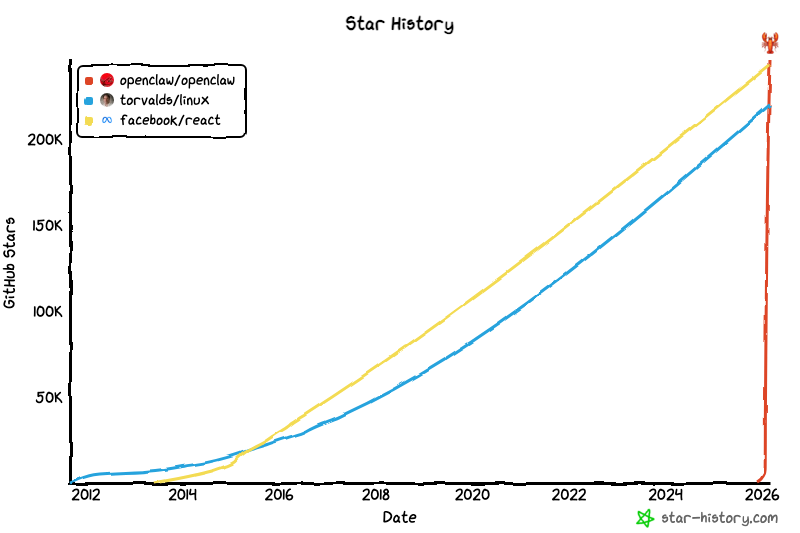
From zero to #1 in under four months. Still climbing. EXFOLIATE! IYKYK.
What I take away from this
Stars don’t tell you what’s good. They tell you what caught attention. Here’s what the data says to me:
The star economy is inflationary. There are way more GitHub users now than when React launched in 2013. More users means more potential starrers per unit of hype. OpenClaw is pulling stars from a pool that’s 4-5x larger than what React started with. That doesn’t invalidate the achievement by any means.
AI projects spread differently than web frameworks. React got adopted because hiring managers put it in job descriptions and teams made architectural decisions around it. OpenClaw gets adopted because people are curious, excited, or a little scared. Maybe all three. Different viral loop. Different star velocity.
And the adoption is wider than developers. This is the part that legit blows my mind! I run OpenClaw(s) on my own server and using compute from Zo.Computer. I’ve built agent infrastructure around it. I’m extremely bullish on it. But I expected adoption to stay technical for a while. It didn’t. There’s a mom on X who has it managing her shopping lists, meal plans, and kids’ activity registrations through a WhatsApp group. A design leader on maternity leave set it up to run her life one-handed between diapers and nursing. People are building family calendar assistants that auto-detect commitments from dentist texts and add driving buffers. Enterprises are adopting it as their first agent framework before even evaluating alternatives. I think this is the future of how we work with software, and I’m not sure we go back.
The aggregator gap keeps growing. The spread between the top list repo (470k) and the top software repo (247k) is 223k stars. Learning resources pull further ahead of actual tools every year. I think that says something interesting about what GitHub has become for a lot of developers.
Speed of accumulation and depth of adoption are measuring different things. React’s 243k over 13 years represents deep infrastructure adoption. OpenClaw’s 247k over 4 months represents peak developer attention. Both are real. They’re not the same thing.
The question I keep coming back to
Is OpenClaw the most important open-source project on GitHub? No IMHO. Linux is. It runs most of the internet’s infrastructure, most Android phones, most cloud servers. It has 220k stars. Git itself isn’t even in the top 100.
OpenClaw getting 247,000 people to click a star button in four months is real. What impresses me most isn’t the star count. It’s the community that showed up around it. The contributors, the creativity, the speed at which people went from “what is this” to building things with it that the creators never imagined. That doesn’t happen by accident. Building software that spreads that fast is worth paying attention to regardless of what you think about AI agents. Stars are a popularity metric. Popularity is interesting data. It’s not the whole story.
Data pulled from the GitHub API on March 2, 2026. Star counts are snapshots and will have changed by the time you read this. Star history chart from star-history.com.
I write about developer fundamentals every week in Main Branch. If this kind of analysis is your thing, come hang out.
About the Author: Andrea Griffiths is a Senior Developer Advocate at GitHub, where she helps engineering teams adopt and scale developer technologies. She's passionate about making technical concepts accessible—to both humans and AI agents. Connect with her on LinkedIn, GitHub, or Twitter/X. · Read in Spanish